
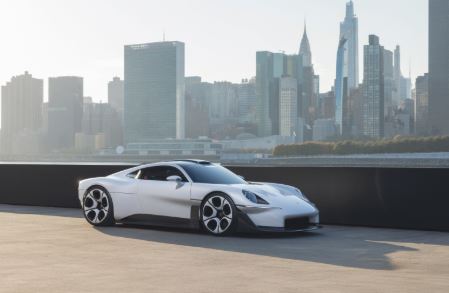
Throughout its history, Porsche has treated design evolution not as a departure from its past, but as a deliberate dialogue with its heritage. As part of its strategic realignment known as “Sportwagenschmiede ’35”, the Stuttgart automaker has unveiled the Porsche Mission S—a forward-looking vision model that signals the brand’s next design chapter and heralds the development of a permanent, mid-engined super sports car platform positioned above the iconic 911.
Celebrating its world premiere at a location steeped in historical significance—a pier in Queens, New York, facing the Manhattan skyline where the seminal 550 Spyder was first photographed in 1953—the Mission S anchors itself on three guiding principles: authentic, consequent, and timeless.
A Permanent Fixture Above the 911
Unlike previous one-off hypercar studies, the Mission S preview serves a fundamentally broader commercial and engineering purpose.
“A Porsche must be recognisable as a Porsche at first glance,” notes Dr Michael Leiters, Chairman of the Executive Board of Porsche AG. “The Mission S provides a glimpse of the ideas and design features that will shape Porsche in the coming years. At the same time, the Mission S represents a mid-engined super sports car platform positioned above the 911 — not as a one-off hypercar, but as a permanent and versatile addition to our customer offering.”
This strategic decision marks the first time Porsche intends to introduce a permanently available super sports car tier above the 911 range, capitalizing on decades of motorsport pedigree to deliver heightened levels of performance and engineering adaptability.
Exterior Architecture: Floating Volumes and Iconic Homages
Shaped under the direction of Tobias Sühlmann, Head of Style Porsche, the exterior of the Mission S reinterprets unmistakable brand hallmarks into a progressive, sculptural form.
The car’s architecture is defined by dramatic width-to-height proportions and what Porsche terms “floating volumes”—surfaces that seem to levitate, visually articulating the vehicle’s lightweight philosophy and aerodynamic efficiency. A continuous wraparound main line binds the front and rear light signatures together. Above this datum, the bodywork exhibits muscular athletic surfacing; beneath it, technical cooling and aerodynamic functions remain deliberately exposed.
Historic motorsport and road-car icons are referenced throughout the bodywork:
- The 911 & G-Model: Evident in the pronounced “torpedo” front fenders, circular headlight graphics, and shut lines that merge flush into the lighting elements.
- The 911 GT1: Directly inspires the ultra-flat front nose and the intricate “car-in-car” floating architecture at the rear.
- The 959: Echoed in the sweeping, dynamic roofline extending beneath the active rear wing straight to the tail.
- The 917 & 928: A cooling system reminiscent of the 917’s legendary horizontal engine fan, paired with lightweight aerodynamic wheels reinterpreting the iconic telephone-dial styling of the 928.
The mid-engined layout preserves Porsche’s hallmark “flyline” while allowing an active rear wing to integrate seamlessly into the body contours.
Driver-Centric Interior: A Return to Purism
Inside, the Mission S departs sharply from the contemporary industry trend of excessive dashboard display screens. Drawing direct inspiration from the minimalist cockpits of the 356 and 550 Spyder, two continuous horizontal lines flow across the dashboard and into the door panels, instilling the sensation of sitting deep inside the machine.
The cabin prioritizes a purist symbiosis of physical tactility and digital technology:
- Reconfigurable Five-Gauge Cluster: Positioned on the driver’s direct sightline behind the steering wheel, the signature five round instruments feature a physical analogue needle over a digital backing display. Depending on the active drive mode, the gauge tubes mechanically shift—sliding side-by-side or stacking behind one another—while bringing the central rev counter closer to the driver to maximize focus.
- Analogue Tactility: Classic toggle switches, physical push-pull dashboard controls, and an updated mechanical-digital Sport Chrono instrument restore physical feedback. The vehicle key dock is positioned traditionally to the left of the steering column.
- Integrated Motorsport Ergonomics: Lightweight bucket seats feature an integrated center-panel seatbelt buckle and relocated electric adjustment switches for clean operation.
- Motorsport Livery: The interior and exterior palette reimagines historic racing liveries through newly developed shades of Firn White Metallic, Light Red Metallic, Black Chrome, and Special Black.
The “Bring-Your-Own-Screen” Driver Experience
Perhaps the most radical decision in the Mission S interior is the complete omission of a permanently fixed center touchscreen or passenger display.
Instead, Porsche introduces a retractable mounting dock equipped with MagSafe technology. The driver or passenger docks their personal smartphone to handle navigation, streaming, and secondary data displays via a streamlined My Porsche App. This setup also allows owners to select customized, heritage-inspired gauge cluster themes on their primary instrument dials, ensuring the dashboard never becomes dated by obsolete infotainment hardware.
By balancing analogue soul with forward-looking design, the Porsche Mission S sets the stage for a new generation of mid-engined performance—proving that the sports car of tomorrow remains deeply rooted in the driver’s seat.

