
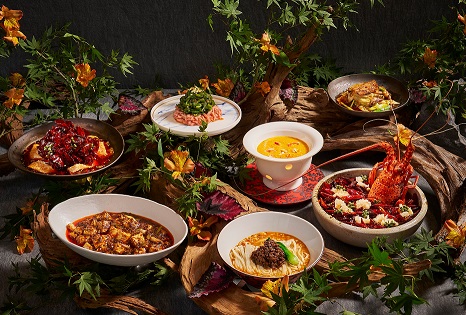
The relaunch of 1-MICHELIN-starred Shisen Hanten by Chen Kentaro promises a fresh, elevated experience for lovers of the unique cuisine of Chūka Szechwan Ryori
Shisen Hanten by Chen Kentaro is a stirring ode to family legacy. This revered brand was introduced to Singapore by third-generation heir, Chef Chen Kentaro; and for ten years hence has delighted local audiences with its unique Chūka Szechwan Ryori (中華四川料理), a form of Szechwan cuisine adapted to Japanese tastes. Now, its relaunch brings the journey to a new level; with transformed interiors and a new menu promising a more enriched, refined and elevated experience for diners.
In 1958, Chen Kenmin opened his first restaurant, Shisen Hanten, in Tamuracho, Tokyo, where he blended authentic Szechwan flavours with Japanese influences. A standout dish in his repertoire was Prawns in Chili Sauce – later renamed Ebi Chili Sauce (エビチリソース). The other was Mapo Tofu, one of the first Szechwan dishes Kenmin brought to Japan, and a staple of the Shisen Hanten menu to this day. Kenmin came to be known as the ”Grandfather of Szechwan Cuisine” in Japan.
Chef Kentaro’s father, Chen Kenichi, was born in 1956. He refined his father’s recipes of Mapo Tofu and Prawns in Chili Sauce (Ebi Chili) by incorporating dou ban jiang (⾖瓣酱), a fermented broad bean paste central to Szechwan cooking. This focus on excellence continues today, with key seasonings like 辣椒油 (chilli oil), 甜⾯酱 (sweet sauce), miso, vinegar, and soy sauce being crafted in-house.
Over time, Kenichi came to be known professionally as Japan’s “Szechwan Sage” (料理の鉄⼈), and to the wider population as one of Japan’s most celebrated ‘Iron Chefs’. He appeared on the popular TV cooking competition series for six years, becoming the longest-serving Iron Chef. He also headed the Shisen Hanten group, which by then operated in Tokyo’s Akasaka, Ikebukuro, and Roppongi districts, as well as in Tokushima City (Tokushima Prefecture), Kure (Hiroshima), Matsuyama (Ehime), and Hakata-ku (Fukuoka).
As the group’s current steward, Chen Kentaro embraces his illustrious pedigree while forging his own path. He began his culinary journey, from the fundamentals. Chef Kentaro studied the Chinese language at a university in Cheng Du, immersing himself in the language and culture. In the afternoons, he returned to work in the kitchen, where he gained a deep appreciation of regional Chinese flavours and ingredients—the foundation of his approach to Chūka Szechwan Ryori at Shisen Hanten today.
In 2014, with the blessings of his family, he opened his own restaurant in Singapore in partnership with OUE Restaurants – Shisen Hanten by Chen Kentaro – which he operates as a brand entity separate from the family business. Kentaro, too, had to learn to adapt to local circumstances, widening his sources to both Japan, China and the region. Like his father before him, Kentaro uses ingredients sourced from suppliers he personally knows and visits
For Kentaro’s efforts, the restaurant was awarded two Michelin stars in 2016, making it the highest Michelin-rated Chinese restaurant in Singapore, a status it maintained until 2023.
Now, the unveiled refurbishment bring this 66-year legacy to even more vivid life with main halls exquisitely reimagined; a beautiful chef’s table and luxurious private rooms installed; and striking artworks specially commissioned to symbolise milestones in the restaurant’s storied history. Within this revitalised space, Chef Kentaro showcases his love for his family’s cuisine as he actively nurtures the next generation of chefs.
Shisen Hanten by Chen Kentaro steps into a new decade with a revitalised interior that bridges the past and present, weaving together stories from Japan, China and Singapore, while celebrating the harmony of diverse cultures.
The redesigned main dining hall features a striking large hanging artwork, which serves as the centrepiece of the space, and sets the tone for the refined yet dynamic atmosphere within. Jadehued Japanese washi paper (和纸) adorn the walls, while soft fabric curtains (布窗帘) gently filter natural light from the windows. Another highlight is a wall with a gradient of light flowing like cascading water, reminiscent of the region’s iconic waterfalls. Wooden fins arranged at random angles further enhance the dynamic play of light.
The new seating arrangement balances intimacy with openness through the careful control of sightlines from every seat for a more tranquil, focused environment. Tables and chairs are made of a combination of woods and are designed to match the overall colour tones of the room, ensuring a cohesive and refined aesthetic. Layout is flexible, with a variety of group sizes seated at tables for four to ten persons.
The main dining room features a thoughtfully arranged layout to accommodate various group sizes. The main central section offers four tables seating four guests each, alongside two tables for six guests. On the left, three six-seater tables provide a more intimate setting, while the right dining space boasts three spacious eight-seater tables, each comfortably accommodating up to ten guests. An artfully designed semi-private dining room for six guests offers privacy within the vibrancy of the main dining hall.
In addition to the main dining area, the restaurant presents four elegantly appointed private dining rooms, each named after iconic cities in Szechwan. The intimate 乐⼭ (Le Shan) Room accommodates up to six guests; while the 重庆 (Chong Qing) Room provides space for eight guests and is perfect for close-knit celebrations. The 天府 (Tian Fu) Room seats ten for slightly larger gatherings and grander events; while the spacious 成都 (Cheng Du) Room hosts up to 20 guests; in all offering an exclusive and luxurious dining experience tailored to every group’s needs. For gatherings of up to 30 guests, the Tian Fu and Cheng Du rooms can be combined into one majestic space.
The new Chef’s Table seats eight and offers a close-up, exclusive opportunity to interact directly with the chefs, and witness the intricate techniques behind Chūka Szechwan Ryori. In its new incarnation, Shisen Hanten by Chen Kentaro provides a dramatically stunning backdrop to all manner of occasion – corporate entertainment, celebrations, or intimate gatherings – and is poised to delight serious gourmands and casual diners alike.
The wine cellar at Shisen Hanten by Chen Kentaro features an elegant, glass-enclosed design with a meticulously arranged wall holding up to 1,740 bottles. Warm lighting highlights each bottle, enhancing the luxurious ambience and inviting guests to explore the extensive selection. In addition to showcasing Coravin devices and decanters, the counter space displays limited and rare whiskies from Scotland and Japan, as well as exclusive Armagnac and Cognac. Suspended pendant lights add a touch of sophistication, making this an impressive focal point in the dining area.
At Shisen Hanten, Chef Chen Kentaro brings to the table Chūka Szechwan Ryori (中華四川料理), a style of Szechwan cuisine adapted to Japanese tastes. This culinary tradition was pioneered by Chen Kenmin, who introduced complex flavours of Szechwan to Japan at a time when they were virtually unknown. Facing challenges in sourcing authentic Szechwan ingredients upon his arrival in Tokyo, he creatively adapted by crafting his own seasonings with Japanese ingredients, such as using sansho pepper in place of Szechwan peppercorns. Iconic dishes like Shisen Hanten’s style of Mapo Tofu (⿇婆⾖腐) and Twice-cooked Pork (回锅⾁) emerged from this ingenuity. By blending traditional Szechwan techniques with local Japanese influences, Chen Kenmin captivated the Japanese palate, giving rise to the unique fusion that defines Chūka Szechwan Ryori today.
While Shisen Hanten’s beloved guest favourites and signature dishes remain central to the menu, Chef Kentaro also brings in fresh inspirations shaped by his experiences and deep understanding of Chūka Szechwan Ryori. With the unveiling of his new menu, Chef Kentaro seeks to preserve authentic flavours while creating modern interpretations. One example is the Steamed Kinmedai with Hot and Sour Sauce with Fresh Yuba, in which Kinmedai (golden eye snapper), a premium Japanese fish rarely seen in Chinese cuisine, is teamed with Szechwan suan la (酸辣) sauce and finished with fresh Japanese yuba for added texture and a layer of flavour.
Chef Kentaro places a strong emphasis on using only the finest seafood, whether dried or fresh. He is deeply committed to sourcing exceptional ingredients, often visiting the fishermen to not only inspect the catch but to gain a deeper understanding of the fish, the environments they inhabit, and the optimal seasons for harvest. Over the years, he has forged meaningful relationships with his trusted suppliers, connections he truly values and nurtures. This dedication shines in seasonal dishes like Monkfish Liver Xiao Long Bao – highlighting Ankimo (monkfish liver), a prized Japanese delicacy at its seasonal peak, paired with the delicate craft of dim sum. The Szechwan-style Osashimi with Homemade Fermented Chilli Pepper Soy Sauce features Madai (sea bream, 真鯛), sourced from Shikoku, Japan, where it is currently in season.
And while his sources span both local and international origins, Chef Kentaro takes particular pride in introducing Singaporean diners to the exceptional produce of Japan. His deep connections with fishermen and farmers is central to this philosophy, as he values the trust and quality that come from these relationships. These may include exceptional produce such as Hokkaido Tokachi Mangalica pork, monkfish and madai (sea bream, 真鯛); vegetables such as Japanese spinach and white negi (Japanese leek, 葱⽩); condiments such as Japanese soy sauce, oyster sauce and sake. Through his close ties with the Mangalica pork supplier in Tokachi, Hokkaido, Chef Kentaro introduces this premium produce to Singapore. Known as the “Kobe beef of pork”, this naturally grazing pig yields meat that is renowned for its sweet, rich flavour and exceptional marbling. A main characteristic of the pork belly is its clearly defined layers of lean meat and fat, giving it an irresistibly indulgent texture. Mangalica pork pairs perfectly with the bold spices of Szechwan cuisine.
At Shisen Hanten by Chen Kentaro, Chef presents the highly-prized Hokkaido Hiyama sea cucumber in a new seasonal dish – Braised Hokkaido Hiyama Sea Cucumber with Japanese Leek. A scarce and rarely exported ingredient, Chef Kentaro prepares the sea cucumber with a timeconsuming and specialised technique, making this unique experience accessible to Singaporeans.
For fans of Mapo Tofu, the menu offers two options – Stir-fried Tofu in Hot Szechwan Pepperflavoured Meat Sauce, or Stir-fried Tofu and Wagyu Beef Tendon in Hot Szechwan Pepperflavoured Meat Sauce, both served with Claypot Hokkaido rice. This signature dish is Shisen Hanten’s tribute to Kentaro’s illustrious forebears and their iconic Mapo Tofu. For the Chef’s Table Experience, the restaurant offers a premium seasonal option – shirako, reflecting Chef Kentaro’s commitment to sourcing and presenting the best seasonal ingredients to his guests.
Address
Level 35, Hilton Singapore Orchard,
333 Orchard Road, Singapore 238867
Opening Hours
Lunch
Monday to Friday
12.00pm to 3.00pm
(last order at 2.30pm)
Saturday, Sunday and Public Holidays
12.00pm to 3.00pm
(last order at 2.30pm)
Dinner
Daily
6.00pm to 10.00pm (last order at 9.30pm)
https://shisenhanten.com.sg/
Reservation & Enquiries
Telephone: 6831 6262
Email: shisenhanten@ouerestaurants.com
 LUXURY ASIA, PREMIUM TRAVEL, LIFESTYLE, TECH, WINE & DINE MAGAZINE