
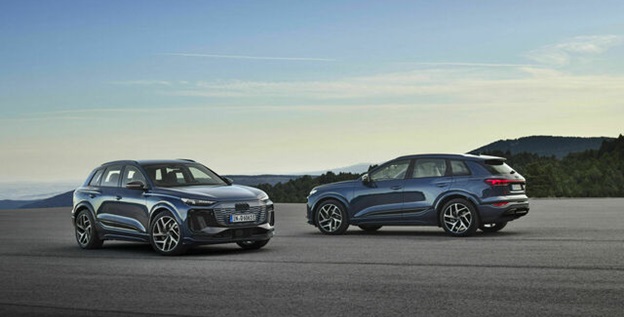
The new models slated for arrival in Singapore across 2025 will further accelerate the Audi product offensive, which kickstarted with the launch of the Audi Q4 e-tron in June 2024. New model introductions include electric additions like the Audi Q6 e-tron and A6 e-tron to strengthen the current e-tron range, in line with Audi’s planned portfolio of 20 battery-powered electric vehicles (BEVs) by 2026. New and improved internal combustion engine (ICE) models will also provide more vehicle options for various customer demographics.
In the first quarter of 2025, the Audi House of Progress Singapore will welcome visitors to its premises at Cross Street Exchange, offering a seamless end-to-end retail experience for consumers. Audi’s new home will give visitors the opportunity to experience and test drive all current and future Audi models, as well as access to a variety of exclusive customer events and lifestyle experiences. This includes the Audi X Burnt Ends Bakery, an all-day dining experience in collaboration with Burnt Ends, that will offer a signature menu of German-inspired bakes.
Audi Singapore 2025 line-up
| Model | Summary | Estimated Arrival |
| 1. Audi Q6 e-tron | The Audi Q6 e-tron, built on the new scalable Premium Platform Electric (PPE), marks the start of a new generation of EVs at Audi.
Balancing range and charging performance, the car has a charging capacity of up to 270 kW (DC) on 800-volt architecture, with up to 255km being recharged in 10 minutes. With two motors, the Audi Q6 e-tron quattro and Audi Q6 Sportback e-tron quattro have a peak combined power output of 382hp, and accelerate from 0 to 100 km/h in 5.9 s. The Audi Q6 e-tron and Q6 Sportback e-tron also comes with rear wheel drive, adaptive cruise control, and S sport suspension. The quattro variant comes with adaptive air suspension, an elevated MMI interface, and an augmented head up reality display. |
Q1 2025 |
| 2. Audi Q6 Sportback e-tron | Q4 2025 |
| 3. Audi A3 Sedan and Sportback | The Audi A3 Sedan and Sportback have been refreshed with sportier design elements, alongside the integration of digital applications and services on demand.
Both models come with a four-cylinder 1.5 litre engine and a smoother drivetrain. Updated standard features and assistant systems, in addition to selectable daytime running light signatures make for a more comfortable and personalised driving experience. A Category A variant of the Audi A3 Sedan and Sportback will also be available in Singapore. Meanwhile, the new Audi S3 models come with upgrades that offer a more dynamic drive. With an increased output of 245 kW and 420 Nm of torque, the Audi S3 accelerates to 100km/h in 4.7 seconds. The torque splitter is now also available in the S3, increasing agility and stability to deliver strong performance. Audi has also upgraded the Audi RS3, representing maximum performance. Powered by an inline five-cylinder engine, the Audi RS3 accelerates to 100 km/h in 3.8 seconds and can reach a top speed of 290 km/h. Chassis fine tuning and brake torque vectoring means that the Audi RS3 accelerates faster through bends. |
Q1 2025 |
| 4. Audi S3 and RS3 | ||
| 5. Audi A6 Sportback e-tron | The Audi A6 Sportback e-tron is the first flat-floor model on the Premium Platform Electric (PPE), boasting an exciting design, dynamic driving experience, and superior efficiency.
With an elevated interior design along with features like digital light signatures and illuminated rings at the rear, the A6 e-tron captures the new design philosophy of Audi. The car comes with an output of 270kW. Additionally, the Audi A6 Sportback e-tron is the most aerodynamic Audi car to date, with a drag coefficient as low as 0.21Cd. Optional adaptive air suspension also provides a balance between ride comfort and sporty handling. |
Q3 2025 |
| 6. Audi A5 Sedan | Audi has refreshed one of their longstanding best sellers in the mid-size segment, the Audi A5 Sedan and S5 Sedan. These will be the first models launched on the Premium Platform Combustion (PPC), replacing the MLB-evo platform.
The Audi A5 Sedan boasts an upgraded drivetrain from 150 hp to 204 hp, and increased torque from 270 Nm to 340 Nm. As a result, acceleration to 100 km/h is now 7.8 seconds, down from 9.1 seconds. With a new MHEV plus system based on a 48-volt on-board electrical system, the Audi S5 Sedan also offers reduced carbon emissions and fuel consumption. New running light signatures and OLED technology further highlights the dynamic design of both models. |
Q2 2025 |
| 7. Audi S5 Sedan | ||
| 8. Audi Q5 and SQ5 | The Audi Q5 will be the first SUV model on the Premium Platform Combustion (PPC), with efficient, partially electrified combustion engines.
The Q5 boasts an output of 150 kW and torque of 340 Nm, while the SQ5 offers an output of 270 kW and maximum torque of 550 Nm. All variants will be equipped with MHEV plus technology, which can provide up to 18 kW of additional power for short periods, and use the 7-speed S tronic dual-clutch transmission. Having debuted in 2020, the Q5 Sportback is entering its next generation, building on the characteristics of the Q5 SUV with an even more dynamic silhouette. The new iteration of the Q5 Sportback will have a sleeker and more technical look, appealing to design-oriented customers. |
Q2 2025 |
| 9. Audi Q5 Sportback and SQ5 Sportback | Q3 2025 | |
| 10. Audi RS Q8 performance | Audi is rounding out the Q8 model range with the Audi RS Q8 performance, the most powerful SUV in Audi’s current line-up. With a twin turbocharged eight-cylinder engine, the car boasts an output of 471 kW and 850 Nm of torque.
It offers outstanding driving dynamics due to an optimised, self-locking center differential, as well as adaptive air suspension with controlled damping. Lighter wheels and an expressive exterior also sharpens the appearance of the Audi RS Q8. Available on indent basis. |
Q1 2025 |
| 11. Audi RS e-tron GT and S e- tron GT | Performance upgrades to the Audi RS e-tron GT and Audi S e-tron GT significantly improve the range, performance, charging, and handling of both models.
The newly developed electric motors offer increased power and acceleration for both cars. The maximum power output for the Audi RS e-tron GT is 680 kW and the Audi S e-tron GT has an output of 500 kW. Acceleration to 100 km/h is 2.8 seconds and 3.4 seconds for both cars respectively. Audi has also increased the charging performance for the cars, offering a maximum charging power of 320 kW and a wider quick charging window. |
Q1 2025 |
 LUXURY ASIA, PREMIUM TRAVEL, LIFESTYLE, TECH, WINE & DINE MAGAZINE