
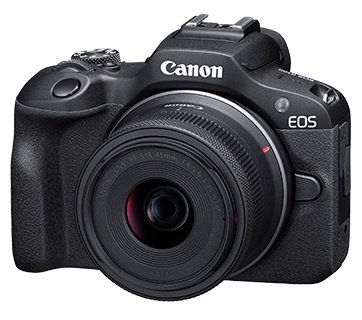
Canon EOS R100
The Canon EOS R100 is an entry-level mirrorless camera that brings Canon’s RF mount system to a more affordable price point. Aimed at beginners and casual photographers looking to step up from smartphone photography, the EOS R100 offers a good balance of features and performance in a compact body.
Key Features:
– 24.1MP APS-C CMOS sensor
– DIGIC 8 image processor
– 4K video recording at 24p (with 1.6x crop)
– Full HD video at up to 60p
– Dual Pixel CMOS AF with 3,975 selectable AF points
– 6.5 fps continuous shooting (4 fps with AF)
– ISO range of 100-12,800 (expandable to 25,600)
– 2.36M-dot electronic viewfinder
– 3.0-inch 1.04M-dot tilting touchscreen LCD
– Built-in Wi-Fi and Bluetooth connectivity
Design and Handling:
The EOS R100 features a compact and lightweight body, making it easy to carry around. Despite its small size, it offers a comfortable grip and well-placed controls. The camera’s menu system is intuitive, especially for those familiar with Canon’s interface.
Image Quality:
The 24.1MP APS-C sensor delivers good image quality with accurate colors and decent dynamic range. The camera performs well in low-light situations, though noise becomes noticeable at higher ISO settings.
Autofocus and Performance:
Canon’s Dual Pixel AF system provides fast and accurate autofocus in most situations. The eye-detection AF works well for portraits. While the 6.5 fps burst rate isn’t class-leading, it’s sufficient for casual photography.
Video Capabilities:
The EOS R100 can shoot 4K video, but with a significant 1.6x crop. Full HD recording is available at up to 60 fps without crop. The lack of in-body image stabilization means you’ll need stabilized lenses or a gimbal for smoother footage.
Battery Life:
The camera’s battery life is rated at approximately 315 shots per charge when using the LCD, which is average for its class. Carrying a spare battery is recommended for all-day shooting.
Lens Compatibility:
As part of Canon’s RF mount system, the EOS R100 has access to a growing lineup of RF lenses. It’s also compatible with EF and EF-S lenses via an adapter.
Pros:
– Affordable entry into Canon’s mirrorless system
– Compact and lightweight design
– Good image quality for its class
– User-friendly interface
– Dual Pixel AF system
Cons:
– Significant crop in 4K video mode
– No in-body image stabilization
– Limited buffer depth for continuous shooting
– Single SD card slot
Verdict:
The Canon EOS R100 is a solid entry-level mirrorless camera that offers good image quality and ease of use at an attractive price point. It’s an excellent choice for beginners or casual photographers looking to upgrade from smartphone photography. While it may lack some advanced features found in higher-end models, the EOS R100 provides a gateway into Canon’s mirrorless ecosystem and delivers satisfying results for its intended audience.
Here’s a comparison of the Canon EOS R50 and R100 cameras:
Sensor and Image Quality
Both cameras feature a 24MP APS-C sensor, but there are some key differences:
The R50 uses a newer sensor with improved microlenses and circuitry, paired with the more powerful DIGIC X processor.
The R100 uses an older sensor design and DIGIC 8 processor from previous models like the M50.
The R50 has a higher native ISO range of 100-32000 (expandable to 51200) compared to the R100’s 100-12800 (expandable to 25600).
While image quality for stills may be similar in good lighting, the R50 likely has an advantage in low light performance.
Autofocus
The R50 has more advanced autofocus capabilities:
Dual Pixel CMOS AF II system with 4,503 AF points
Subject detection for humans, animals (dogs, cats, birds) and vehicles
The R100 uses an older Dual Pixel CMOS AF system with 3,975 points and only human detection.
Video Capabilities
This is an area of significant difference:
R50: Uncropped 4K/30p, 4K/60p with 1.56x crop, 1080/120p slow motion
R100: 4K/24p with heavy 1.6x crop, no 4K/60p, 1080/60p max
The R50 is clearly superior for video work, especially with its uncropped 4K.
Design and Controls
Both have similar dimensions, with the R100 being slightly lighter (356g vs 375g)
The R50 has a vari-angle touchscreen, while the R100 has a fixed non-touch LCD
R50 has an extra customizable ISO button on top
Other Features
The R50 has a multi-function hot shoe compatible with digital audio accessories, while the R100 has a standard hot shoe
R50 viewfinder can operate at 120fps vs 60fps max on the R100
R50 offers faster burst shooting: 12fps mechanical / 15fps electronic vs 6.5fps on the R100
Current Price of R100 and R50 below
The best lens to go with your R50 and R100 is the 50mm f1.8, at an affordable price, see current promotion:
Conclusion
The R50 is clearly the more capable camera, especially for video work and fast action photography. Its newer sensor, better AF system, uncropped 4K video, and vari-angle touchscreen justify the $200 price difference for most users. However, the R100 could be sufficient for casual photographers primarily interested in still images who want to save some money.
 LUXURY ASIA, PREMIUM TRAVEL, LIFESTYLE, TECH, WINE & DINE MAGAZINE