
Canon Enhances RF Lineup with Three New Hybrid Lenses
The RF70-200mm f/2.8L IS USM Z, RF50mm f/1.4L VCM, and RF24mm f/1.4L VCM blend video-centric usability with classic focal lengths
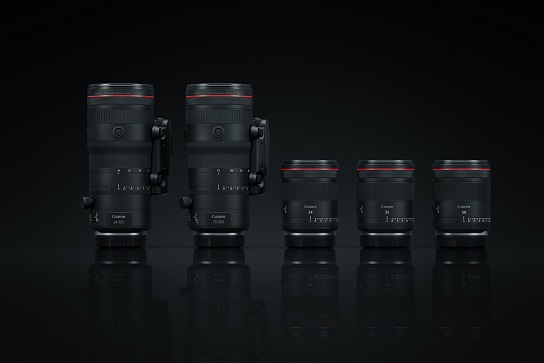
Canon today announced the RF70-200mm f/2.8L IS USM Z, RF50mm f/1.4L VCM, and RF24mm f/1.4L VCM, a trio of hybrid RF lenses that will be an integral part of the hybrid shooter and video creators’ toolkit. The lenses combine classic focal length and maximum aperture, and their EF mount predecessors have been popular among professionals for decades.
“These new lenses demonstrate our commitment to continuously refine the EOS R System and RF Lens ecosystem. Built with the modern creative’s shooting requirements in mind, we are confident that these new hybrid lenses will stand up to the most challenging shooting needs,” said David Yeo, Senior Marketing Manager of Consumer Business, Singapore Operations, Canon Singapore.
The new hybrid lenses have:
- Large maximum apertures to create beautiful bokeh, enhance AF performance and flexibility in low light environments.
- 11 circular aperture blades that maintain beautifully round bokeh even at narrower apertures.
- An iris ring that enables smooth, seamless aperture changes while shooting[1]
- High-precision, quiet AF drive control that eases workflows, allowing creators to focus on creative aspects such as framing.
- An electronic floating focus control system designed to suppress focus breathing, minimising unexpected changes in composition.
- Bodies designed for easier use with rigs and gimbals.
- Unified external dimensions, filter diameters, and controls as other lenses in the same subseries (RF70-200mm f/2.8L IS USM Z and RF24-105mm f/2.8L IS USM; RF50mm f/1.4L VCM and RF24mm f/1.4L VCM with RF35mm f/1.4L VCM), allowing better interchangeability when used together.
These video-centric features can also be found on the previously released RF24-105mm f/2.8L IS USM Z and RF35mm f/1.4L VCM. As professional-grade L-series lenses, the three new lenses feature a durable drip-and dust-resistant design, smudge-resistant fluorine coating on the front and rear lens surfaces, and superior optics. These features provide beautiful colours and clean, sharp images even under challenging conditions such as backlight. Besides the video-centric features, the lenses have other technologies and specifications that will appeal to still shooters.
Classic Telephoto Zoom Lens Upgraded for Video
After the RF24-105mm f/2.8L IS USM Z, the RF70-200mm f/2.8L IS USM Z is the second professional hybrid zoom lens that supports advanced, smooth motor-powered zoom control via the Power Zoom Adapter PZ-E2/PZ-E2B (sold separately). It supplements the RF24-105mm f/2.8L IS USM Z with its longer 70-200mm telephoto focal range, capturing high-quality photos and videos of scenes or subjects that are further away such as sports, news and events.
For scenes that require even further reach, the RF70-200mm f/2.8L IS USM Z can be used with extenders, which increase the lens’ zoom range to 98 to 280mm at f/4 with Extender RF 1.4x, and 140 to 400mm f/5.6 with Extender RF 2x. Concurrently, it is also capable of close-ups of small objects – at its 200mm end, it has the closest focusing distance of 0.68m and a maximum magnification of 0.3x. Two Nano USMs (Ultrasonic Motor) in an electronic floating focus control system ensure swift, precise autofocusing while delivering high image quality from close focus to infinity.
The RF70-200mm f/2.8L IS USM Z’s fixed-length barrel and internal focusing design retain the same centre of gravity during zooming, making it easier to use with a gimbal or rig. The RF mount’s design flexibility also enables a more efficient build. The lens is approximately 25% lighter than the similarly built EF70-200mm f/2.8L IS III USM. Its tripod mount can be easily attached and detached without tools to accommodate different setups and shooting styles.
For handheld shooting, the lens boasts powerful image stabilisation (IS) capabilities equivalent to 5.5 stops in the centre (lens alone), 7.5 stops in the centre and 7 stops in the corners. This is achieved through Coordinated Control IS with a compatible camera equipped with In-Body IS. Additionally, users can capture sharper handheld images and steadier handheld video in low light conditions. The same three-mode IS that is available in the RF24-105mm f/2.8L IS USM Z can also be found in the RF70-200mm f/2.8L IS USM Z, improving the user experience since both lenses can be used interchangeably with ease.
As the exterior interface and physical measurements of the RF70-200mm f/2.8L IS USM Z are similar to the RF24-105mm f/2.8L IS USM Z, users can switch seamlessly between these two lenses. This is useful for situations such as video production where users will not be required to adjust their shooting setup if the lenses are swapped.
The RF70-200mm f/2.8L IS USM Z comes in two colour variations, a heat-reflective white to prevent heat buildup during outdoor shoots, and standard inconspicuous black for use on sets where gear should blend in with minimal reflections.
f/1.4 Prime Lenses for Greater Cinematic Expression
As photo and video hybrid prime lenses, the RF50mm f/1.4L VCM and RF24mm f/1.4L VCM are designed to work seamlessly and interchangeably with the RF35mm f/1.4L VCM. Like the latter, both balance lightweight, compact bodies with stunning edge-to-edge image quality and a large f/1.4 maximum aperture. This creates beautiful cinematic shallow focus (bokeh), allowing users to create expressive, layered visuals that separate the subject from the background and enhance each focal length’s unique perspective.
The ultra wide-angle RF24mm f/1.4L VCM provides prominent perspective exaggeration with an angle of view wider than that seen by the human eye, making scenes look more vivid and immersive. Meanwhile, the RF50mm f/1.4L VCM’s standard angle of view produces a natural perspective that endows subjects with a lifelike presence. They complement the RF35mm f/1.4L VCM’s images with different perspectives, allowing users to select the lens that best fulfils their objectives.
The RF50mm f/1.4L VCM and RF24mm f/1.4L VCM have the same colour rendering, image characteristics, and operations with the RF35mm f/4L VCM. The dimensions are consistent, down to the 99.3mm-long body, similar weights, and 67mm front filter diameter. This makes them convenient to swap when shooting videos with a rig or gimbal, and compact enough for shooting handheld outdoors. In addition to a screw-in filter, the RF24mm f/1.4L VCM is also bundled with a rear filter holder for sheet-type filters.
Autofocus is driven by Canon’s new VCM (Voice Coil Motor) combined with a Nano USM, facilitating exceptionally quiet AF operation during video shooting. This results in a precise and swifter subject acquisition and tracking.
Pricing and Availability
| Model | Recommended Retail Price | Availability |
| RF70-200mm f/2.8L IS USM Z |
To be advised at a later date |
November 2024 |
| RF50mm f/1.4L VCM | December 2024 | |
| RF24mm f/1.4L VCM | December 2024 |
More information is available at https://sg.canon.
Product Specifications
| Lens | RF70-200mm f/2.8L IS USM Z |
| Focal Length | 70-200mm |
| Maximum Aperture | f/2.8 |
| Minimum Focusing Distance | 0.49m (focal length = 70mm)
0.68m (focal length = 200mm) |
| Maximum Magnification | 0.2x (focal length = 70mm)
0.3x (focal length = 200mm) |
| Lens Construction | 18 elements in 15 groups |
| Filter Size Diameter | Ø82mm |
| Aperture Blades | 11 |
| IS (CIPA Standard Correction Effect) | Yes (up to 5.5 stops) |
| Coordinated Control IS (With IBIS equipped Camera) | Yes (up to 7.5 stops) |
| Maximum Diameter And Length | Approx. 88.5mm × 199mm |
| Weight | Approx. 1115g (White model, without tripod mount)
Approx. 1110g (Black model, without tripod mount) |
| Lens | RF50mm f/1.4L VCM | RF24mm f/1.4L VCM |
| Focal Length | 50mm | 24mm |
| Maximum Aperture | f/1.4 | f/1.4 |
| Minimum Focusing Distance | 0.4m | 0.24m |
| Maximum Magnification | 0.15x | 0.17x |
| Lens Construction | 14 elements in 11 groups | 15 elements in 11 groups |
| Filter Type | Front of lens | Front of lens, Rear Filter holder |
| Filter Size Diameter | Ø67mm | Ø67mm |
| Aperture Blades | 11 | 11 |
| Iris Ring | Yes | Yes |
| Maximum Diameter And Length | Approx. 76.5mm x 99.3mm | Approx. 76.5mm x 99.3mm |
| Weight | Approx. 580g | Approx. 515g |
 LUXURY ASIA, PREMIUM TRAVEL, LIFESTYLE, TECH, WINE & DINE MAGAZINE