
EOS R1: Be One with Mastery
Powerful, reliable, intelligent, and rapid, Canon’s top of the line EOS R system camera is geared up to ace the action.
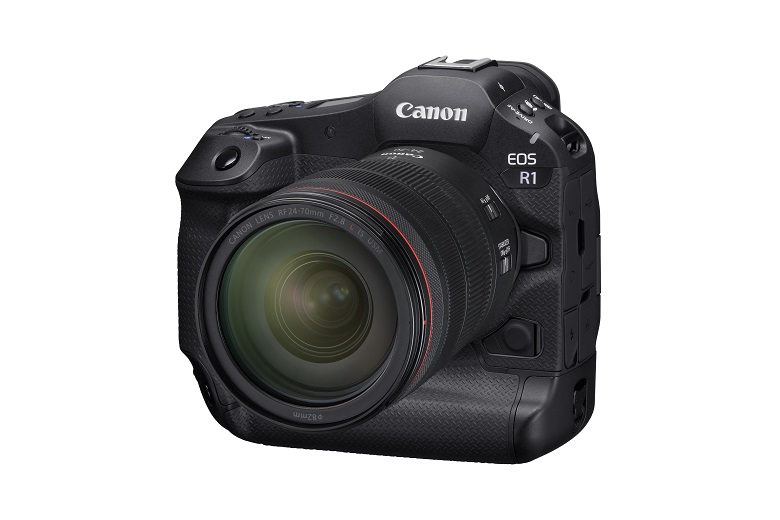
Canon announced the EOS R1, a full-frame mirrorless camera and its first flagship EOS R system camera. With its powerful new image processing and autofocus systems, the new camera is setting new standards and redefining speed in the digital era.
“As the pinnacle of our EOS line up, the EOS R1 inherits the top-tier excellence of our 1 lineage, which has always been highly trusted by professionals. The EOS R1 will empower professionals and craftsmen with class-leading control and performance, to acquire mastery of their craft, by providing an additional edge in their professional production processes and workflows.” said David Yeo, Senior Marketing Manager of Consumer Business, Singapore Operations, Canon Singapore.
Top Notch Speed: Accelerated Capture Image Processing
The EOS R1 harnesses the power of a 24-megapixel back-illuminated (BSI) stacked CMOS sensor to elevate images to an impressive 96-megapixels with its unique In-Camera Upscaling technology. The sensor’s improved light efficiency and faster readout lay the foundation for the revolutionary capabilities of the EOS R1.
With the new Accelerated Capture image processing system, featuring the innovative DIGIC Accelerator alongside DIGIC X, processing speed and power are significantly amplified. Unprecedented levels of AF and subject tracking performance can be achieved through deep learning algorithms, where detailed scene analysis is enabled. With features such as In-Camera Upscaling and Neural Network Noise Reduction now executable in-camera, the EOS R1 supports fast-paced, time-sensitive workflows, ensuring the swift delivery of high-quality, publication-ready images to editors or press offices.
Capture Decisive Moments: Smarter Subject Detection and Tracking
The EOS R1 is Canon’s first camera to feature the next-generation Dual Pixel Intelligent AF system. This system leverages the Accelerated Capture image processing system’s powerful processing speed and power to achieve AF and subject detection performance that significantly surpasses that of the EOS R3.
One revolutionary new AF feature is the Action Priority AF mode, which detects crucial actions such as shooting, passing, and heading, specific to soccer, basketball, or volleyball. Using deep learning, details such as ball position, players’ joints, and the presence of multiple people will be analysed. Once such actions are detected, the AF frame automatically switches to the subjects performing these actions, capturing those split-second decisive moments that might be missed, especially during dynamic, fast-paced games.
Be it shooting event photos or videos, the Register People Priority feature will come in handy; the camera will prioritise up to 10 specific preregistered individuals and constantly focus on them, even when the subjects’ faces are side facing.
Users can also look forward to improved AF and subject tracking in the existing People, Animal, and Vehicle-priority modes, as the Dual Pixel Intelligent AF is aided by Cross-type AF, which improves the camera’s ability to detect small subjects and subjects affected by patterns and/or horizontal lines—such as players wearing horizontal stripes or when shooting from behind net or fence.
In-camera Upscaling: Instant High-resolution Extreme Crops
The new In-Camera Upscaling function uses deep learning algorithms to quadruple the number of pixels in an image while preserving details and image quality, achieving image files that resemble those shot on a 96-megapixel camera. This will be useful for achieving high-quality extreme crops on the spot, which can be sent directly from the camera to a press office.
Image noise can become more apparent when images are magnified, but this will be addressed by the new in-camera Neural Network Noise Reduction function to improve image quality further. The function uses deep learning-based algorithms to reduce high-fidelity noise on RAW images, achieving amazingly clean high ISO JPEG images straight out of the camera.
The EOS R1 features a 5-axis In-Body IS (Image Stabilizer), with a newly designed mechanism and improved algorithms that increase its effectiveness compared to the EOS R3. When shooting with a compatible RF lens with Optical Image Stabilizer, users can expect up to 8.5 stops’ equivalent image stabilisation1 so handheld shot images where tripods are not available will remain sharp.
Never Miss Crucial Moments
The EOS R1 can shoot high-speed bursts at up to 40 fps with the electronic shutter, which allows for silent shooting, and up to 12 fps with the mechanical and electronic first-curtain shutter. This enables users to capture the perfect moment within fast action sequences. The faster sensor readout speed reduces rolling shutter distortion to practically negligible levels. This is equivalent to the EOS-1D X Mark III mechanical shutter, which will encourage users who previously refrained from using the electronic shutter due to potential subject distortion when capturing high-speed action. Reduced rolling shutter distortion will also benefit video, allowing for seamless action footage and fast camera movement without wobbly artifacts.
The EOS R1 comes with pre-continuous shooting for stills and pre-recording for videos. These functions capture moments before pressing the shutter or starting to record, making up for lost split-seconds. The pre-recording function captures up to 20 frames before the shutter button is fully pressed and can be combined with Action Priority AF or Register People Priority. It also captures a scene up to 5 seconds before recording video and stops recording when there is a change of scene, reducing unnecessary footage and streamlining post-production work.
Seamless Operation on the Field
The EOS R1 is also designed for seamless control and operation, enabling better responsiveness to dynamic situations. Eye Control AF, which allows users to control the AF frame with their eyes has been improved with new line-of-sight optics and detection algorithm, allowing for a faster, more reliable line of sight detection. The 9.44 million-dot, 0.9x magnification blackout-free EVF, which offers the highest definition and magnification in the EOS series, ensures that users get a large, bright, clear, and uninterrupted view of their subject and should satisfy even the DSLR users. An anti-fog structure in the EVF prevents fogging even under hot and humid conditions.
Several new design and interface features provide more shortcuts for instant recall of stored AF settings, allowing faster user response to changing shooting conditions. These include:
· Focus preset, a function previously available only on super telephoto lenses that enables any camera button to be assigned to set the focus to a predetermined focus position so users can set focus instantly on a desired area.
· 2-level AF-On button functionality, where the AF-On button can be assigned to change different settings when half-pressed and fully pressed.
· Ability to register and recall different AF settings for different activities and shooting situations preregistered by the user.
Two CFexpress Type-B slots support steady high-speed recording of data-intensive files, such as 6K 60p RAW videos and 40 fps full-resolution burst images, to either card, with the other card available for simultaneously recording still images and proxy video files.
With dual shooting function, users can simultaneously record Full HD 60p videos and 16:9 JPEG, approx. 17.8-megapixel still images, improving efficiency in situations such as breaking news, interview videos where both stills and videos are required.
The EOS R1 is built with a light but strong magnesium alloy exterior, making it 23% lighter and 11% smaller than the EOS-1D X Mark III. It maintains an impact-resistant build and has dust- and water-resistant weather-sealing, to withstand extreme weather conditions.
Designed for Swift Editorial Workflows
The EOS R1 is the first EOS system camera to support the new Wi-Fi 6/6E wireless protocol in addition to the existing 5Ghz and 2.4Ghz bands, allowing for faster wireless file transmission to a smartphone, PC, or FTP/FTPS/SFTP server. It also supports the new high-speed 2.5GBase-T wired LAN protocol to existing wired LAN support. Users can use the latest high-speed communication standards to swiftly transmit large numbers of still photos and videos to their editors—an asset for news reporting where time is of the essence.
Other features that will benefit professional media workflows include:
· More precise deep learning-based metering
The combination of smaller metering zones and expanded deep learning applications enables improved white balance and autoexposure accuracy across various scenes. Thus, photographers can rely more on the camera to produce accurate skin tones and sky colours, as well as more vivid greens. This enables users to rely more on the camera to determine the best settings when handling unpredictable, fluctuating environments. It also results in more beautiful images straight out of the camera.
· Blurred/out of focus image detection
This function analyses and scores blurred and out-of-focus JPEG/HEIF images with people’s faces shot using the electronic shutter. It streamlines reviewing and selects the best images from the tremendous number captured by the high-speed electronic shutter, allowing photographers to upload their images sooner.
· Powerful industry-standard video options
Besides its 6K 60p internal RAW video capability, the EOS R1 adopts many advanced video features shared with the Cinema EOS, such as Canon Log 2 and 3, false colours, and proxy recording. It is also the first EOS series camera to include the Custom Picture colour presets and support for in-camera LUT applications, previously exclusive to Cinema EOS cameras.
· Greater usability with Speedlites
The EOS R1’s faster sensor readout speed enables flash photography support even during continuous shooting in the electronic shutter mode. The flash sync speed is the EOS R series’ highest at 1/400 sec, allowing more flexibility to use a wide aperture or freeze action without resorting to high-speed sync.
Pricing and Availability
The EOS R1 will be available at the recommended retail price of $9599 at Canon authorised dealers in November 2024.
Product Specifications
|
Camera Model |
EOS R1 |
|
Image Processor |
DIGIC Accelerator & DIGIC X |
|
Image Sensor Camera Effective Pixels |
Effective sensor size: Full-Frame CMOS Camera effective pixels: Max approx. 24.2 megapixels |
|
Metering System |
Based on image sensor output signals Stills: 6,144 zone (96 × 64) metering
Movie: DCI: 4,800-zone (96 x 50) metering UHD: 5,184-zone (96 x 54) metering |
|
Autofocus Method |
Spot AF, 1-point AF, Expand AF area (above / below / left / right or around), Flexible Zone AF 1 / 2 / 3, Whole area AF |
|
Image Stabilizer (IS) System |
In-body 5-axis sensor-shift image stabilisation (Still/Movie) |
|
Effective ISO |
Stills: 100–102,400 (L: 50, H1: 204,800, H2: 409,600)
Movie: Custom Picture (Off): 100–32,000 (H: 40,000-102,400, H1: 204,800) Canon 709/PQ/HLG: 400–32,000 (L: 100-320, H: 40,000-102,400, H1: 204,800) Canon Log 2 / Canon Log 3: 800–32,000 (L: 100-640, H: 40,000-102,400, H1: 204,800) BT.709 Standard: 160–32,000 (L: 100-125, H: 40,000-102,400, H1: 204,800) |
|
Continuous Shooting |
Mechanical shutter & Electronic 1st curtain: 12 fps Electronic shutter: 40 fps |
|
Max Shutter Speed |
1/64,000 sec. (Electronic Shutter) |
|
Viewfinder |
0.64-inch OLED, approx. 9.44 million dots 59.94/119.88 fps Refresh Rate |
|
Movie |
6K RAW (6,000 x 3,164) 59.94 fps / 29.97 fps / 23.98 fps (NTSC) 50.00 fps / 25.00 fps / 24.00 fps (PAL)
4K DCI (4,096 x 2,160) 119.88 fps / 59.94 fps / 29.97 fps / 23.98 fps (NTSC) 100.00 fps / 50.00 fps / 25.00 fps / 24.00 fps (PAL)
4K UHD (3,840 x 2,160) 119.88 fps / 59.94 fps / 29.97 fps / 23.98 fps (NTSC) 100.00 fps / 50.00 fps / 25.00 fps (PAL)
2K DCI (2,048 x 1,080) 239.76 fps / 119.88 fps / 59.94 fps / 29.97 fps / 23.98 fps (NTSC) 200.00 fps / 100.00 fps / 50.00 fps / 25.00 fps / 24.00 fps (PAL)
Full HD (1,920 x 1,080) 239.76 fps / 119.88 fps / 59.94 fps / 29.97 fps / 23.98 fps (NTSC) 200.00 fps / 100.00 fps / 50.00 fps / 25.00 fps (PAL) |
|
Maximum Movie Recording Time |
6 hr. 00 min. 00 sec. (Normal movie) 1 hr. 30 min. 00 sec. (High Frame Rate Movie) |
|
Recording Media |
Supports 2 memory cards: • 2 x CFexpress memory card (Type B compatible)
*CFexpress 2.0 and VPG400 supported *Up to 2 TB capacity supported (CFexpress card exceeding 2TB capacity is handled as 2 TB) |
|
Power Supply |
LP-E19 |
|
USB charging / Optional Power |
Supports charging via USB Power Adapter PD-E1 / PD-E2 AC Power (AC Adapter AC-E19 and DC Coupler DR-E19) |
|
Size |
Approx. 157.6 × 149.5 × 87.3 mm |
|
Weight |
Approx. 1115 g (incl. battery and memory 1 card, excl. body cap, eyecup or shoe cover) |
|
Network |
Wi-Fi: IEEE802.11b/g/n/a/ac/ax Bluetooth: Bluetooth Low Energy Technology Ver 5.3 Ethernet: IEEE 802.3bz (for 2.5GBASE-T) |
|
C2PA |
Supported in 2025 or later (firmware update is required) |
EOS R5 Mark II: Imagine Bigger Things
Ignite your creativity with up to 8K 60p RAW video, Dual Pixel Intelligent AF, Neural Network Noise Reduction and a host of powerful functionalities
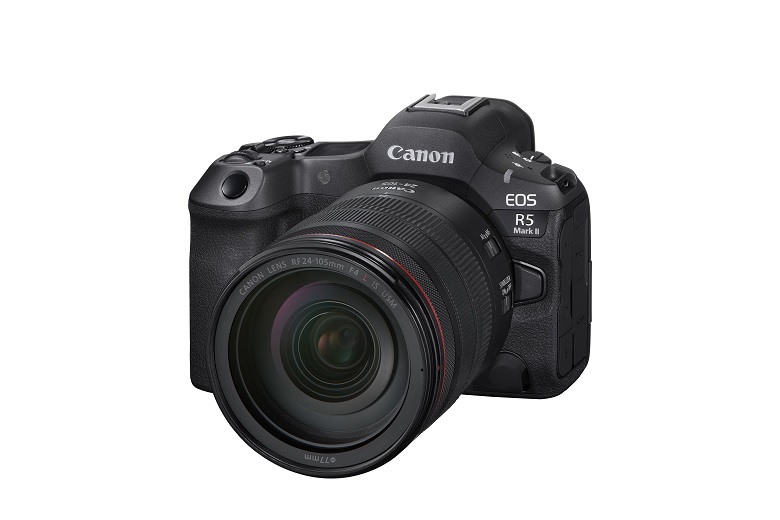
Canon announced the EOS R5 Mark II, a new full-frame mirrorless camera that outperforms the EOS R5, with groundbreaking features like the high-performance new 45-megapixel back-illuminated (BSI) stacked CMOS sensor and Accelerated Capture image processor system. Additionally, it includes enhancements such as Eye Control AF and Cinema EOS features, bringing Canon’s esteemed “5 series” from the EOS system into the next generation.
“For content creators who dare to dream the impossible, we have the perfect tool for them, the EOS R5 Mark II. With this camera, they now possess the ability to turn their imagination into reality. The EOS R5 Mark II, with its new upgrades and functions, is truly for the creative visionaries of tomorrow”, said David Yeo, Senior Marketing Manager of Consumer Business, Singapore Operations, Canon Singapore.
A Power-packed New Core for Unprecedented Performance
The new 45-megapixel back-illuminated (BSI) stacked CMOS sensor leads the host of feature upgrades. The new Accelerated Capture System, consisting of the all-new DIGIC Accelerator and the DIGIC X image processor, can process high volumes of data at unprecedented speeds. Together, the two pave the way for powerful new features and enable resource-intensive processing that sets new standards for AF performance.
Dual Pixel Intelligent AF for Smarter Subject Detection and Tracking
Like the EOS R1, the EOS R5 Mark II is also equipped with the Dual Pixel Intelligent AF system, which leverages the Accelerated Capture system and deep learning. This system greatly improves subject tracking and detection during video and stills shooting. It is highly accurate and capable of tracking the subject even for scenes that were challenging for the EOS R3, like when subjects cross each other and block the main subject.
Videographers and photographers shooting events and concerts will benefit from the Register People Priority function, as it prioritises a preregistered person for subject detection and tracking even when they are in a crowd and have their face turned sideways. The new Action Priority AF mode will automatically switch the focus point to subjects that are shooting, passing, or heading, helping sports photographers capture decisive moments during dynamic, fast-paced sports such as soccer, basketball, and volleyball.
Intuitive and Highly Responsive AF Control
For the first time ever on a “5 series” camera, Eye Control AF allows user to shift the AF frame by simply looking at their new subject to focus on. Updated optics and an improved line-of-sight detection algorithm have doubled the detection frame rate as compared to the EOS R3, thus allowing faster, steadier eye movement detection.
Both photographers and videographers can also store and recall a specific focus position by utilising the focus preset function, which was only previously available on super telephoto lenses. They can register and recall up to six different AF-related settings, which allows for a quicker response to different situations.
Cinema Industry Standards for Next Level Video Production
In addition to the creative flexibility offered by its internal 8K DCI 60p RAW video recording support, the camera also provides ample industry-standard recording modes and options. Several professional production-oriented Cinema EOS system features were also included for professional filmmaking and video production needs.
The new 4K DCI 60p SRAW recording option uses the camera’s full horizontal angle of view and provides a less resource-intensive option for projects requiring RAW video’s post-production latitude. Users can simultaneously record smaller 2K, a newly included function or Full HD proxy video files to the camera’s SD card slot and 8K or 4K main files to the CFexpress Type B slot. This allows users to edit footage more efficiently. The EOS R5 Mark II possesses the ability to create spectacular 4K videos with oversampled 8K sensor output and 2K/FHD videos from oversampled 4K. In addition, the camera showcases beautiful slow-motion scenes in 4K quality (up to 5x slower) or in Full HD (up to 10x slower) with the 4K 120p or Full HD 240p.
Elevate Your Visual Storytelling
Both the EOS R1 and EOS R5 Mark II are the first EOS system cameras to offer 10-bit Canon Log 2, which provides more vivid colour reproduction. Favoured by many filmmakers for its wider dynamic range (16+ stops) and better preservation of shadow detail, Canon Log 2 expands the possibilities of post-production to meet your boundless artistic visions.
Besides the existing Picture Style colour profiles, the EOS R5 Mark II is also equipped with the Cinema EOS system’s Custom Pictures. The latter allows LUTs (lookup tables), including custom 3D LUTs for Cinema EOS to be applied in-camera even when recording in Canon Log 2/Log 3, or HDR formats so users can better visualise the output video while shooting.
Easy integration with Cinema EOS
The EOS R5 Mark II uses the new XF-AVC S/XF-HEVC S file system, which has similar specifications as the Cinema EOS file system. This system enables workflows that are incompatible with the conventional MP4 format and streamlines the multi-camera projects editing process where Cinema EOS cameras are utilised.
Cinema EOS tools that provide detailed exposure information, such as the waveform monitor, false colours, and zebra display, have also been incorporated. Users can fine-tune exposure more accurately on set and improve efficiency on multiple camera shoots where exposures must be matched.
Seize the moment
The pre-recording feature, inherited from Cinema EOS cameras, will benefit users tasked to capture defining moments. This feature captures a scene up to 5 seconds before recording starts, and can be controlled remotely via the Camera Connect mobile app. There is no need to record continuously, which means smaller file sizes, effectively reducing the time users spend reviewing their footage.
Other significant video features:
· Reduced rolling shutter distortion: The new BSI stacked sensor’s faster readout reduces rolling shutter distortion by approximately 40% compared to the EOS R5. This provides seamless action footage and fast camera movement without wobbly artifacts.
· Apple ProRes RAW external recording up to 8K 30p: This feature is supported through an HDMI Type-A output terminal. Users can simultaneously record 2K DCI proxy files to the CFexpress card.
· Linear PCM 24-bit 4-channel input support: This provides high-quality audio and flexibility for multi-microphone setups that are suitable for interviews and simultaneous ambient noise recording.
· Heat dissipating structure: The camera adopts a structure that dissipates heat buildup, allowing reliable recording even at the highest resolutions.
· Optional cooling fan for longer high-resolution recording: A cooling fan, Cooling Fan CF-R20EP (sold separately) extends 8K recording times, allowing up to 120 or more minutes of 8K 30p video to be recorded. It also enables limitless 4K 60p video recording with no overheating restrictions.
· Support for the latest wireless/wired communication protocols (Wi-Fi 6/6E and 2.5G Base-T wired LAN): These allow high-speed transmission of large photo and video files to a PC or FTP/FTPS/SFTP server, which is suitable for news reporting and editorial work especially with time constraints.
In-Camera Image Enhancements
The EOS R5 Mark II improves workflow efficiency and image quality through in-camera noise reduction and image upscaling that uses deep learning technology.
Neural Network Noise Reduction reduces the noise in high-ISO RAW images while retaining detail and resolution.
In-camera Upscaling function that quadruples the number of pixels in the image, increasing the resolution to up to 179 megapixels with minimal impact on image quality.
Combine both to generate cleaner, high-quality extreme crops that retain stunning clarity and detail, further empowering users to unleash their creativity.
Other significant still image features:
· Blurred/Out-of-focus image detection: This function is applicable to JPEG and HEIF images shot with the electronic shutter. It detects and rates images with faces that are blurred or out of focus. Users will also find it easier to choose the best shots from the many captured via improved high-speed continuous shooting performance with the electronic shutter.
· Dual Shooting: Users can simultaneously record 16:9, approx. 33.2-megapixel JPEG still images while recording Full HD 30p videos. This improves work efficiency for users who require still photos and videos of the same event when time is limited.
Delightful and reliable to shoot with
Designed to perform reliably on demanding shoots, the EOS R5 Mark II is built like the EOS R5, with similar dust- and drip-resistant weather sealing to withstand challenging weather conditions. For added protection, users may consider pairing it with the new Shoe Cover ER-SC3. The Rain Cover ERC-R5S / ERC-R5L will also come in useful for users shooting with the EOS R5 Mark II under rainy conditions for a prolonged period. The blackout-free EVF is twice as bright as the EOS R5’s and is equipped with superior anti-fog performance, which provides a brighter, clearer view of the scene even in unpredictable weather conditions. The Eyecup ER-KE can be added to provide a better EVF experience by blocking out stray lights to improve visibility and achieve more precise Eye Control AF.
The EOS R5 Mark II features a 5-axis In-Body IS (Image Stabilizer), with a newly designed mechanism and improved algorithms that increase its effectiveness when compared to the EOS R3. When shooting with a compatible RF lens with Optical Image Stabilizer, users can expect up to 8.5 stops’ equivalent image stabilisation1 so handheld images where tripods are not available will look even better up close.
To meet increased power requirements, the EOS R5 Mark II is powered by a new battery, Battery Pack LP-E6P, which has a higher current discharge but keeps the same form as other LP-E6 series batteries and can be charged with the LC-E6 charger. The USB Power Adapter PD-E2 (sold separately), can also charge the battery inside the camera and supplies more power than the USB Power Adapter PD-E1.
The USB Power Adapter PD-E2 can be combined with the DC Coupler DR-E6P, a new DC coupler for LP-E6 series-type batteries, to supply power directly to the camera during long shoots such as events or time-lapse recording. For enhanced operability such as vertical shooting support, users can combine the EOS R5 Mark II with:
· Battery Grip BG-R20: A battery grip with weight balance, buttons, and multi-controller position optimised for vertical shooting. It is compatible with the EOS R5/ R6 Mark II/ R6.
· Battery Grip BG-R20EP: A battery grip with the same features as BG-R20, with an additional 2.5G Base-T Ethernet port to support high-speed wired communication. This meets the needs of professional users who require wired network compatibility and better support for vertical shooting.
Pricing and Availability
The EOS R5 Mark II will be available at Canon authorised dealers in end August 2024 at the following retail price.
|
Model |
Recommended Retail Price |
|
EOS R5 Mark II (Body only) |
$5999 |
|
EOS R5 Mark II (With the RF24-105/4L IS USM) |
$7899 |
Product Specifications
|
Camera Model |
EOS R5 Mark II |
|
Image Processor |
DIGIC Accelerator & DIGIC X |
|
Image Sensor Camera Effective Pixels |
Effective sensor size: Full-Frame CMOS Camera effective pixels: Max approx. 45.0 megapixels |
|
Metering System |
Based on image sensor output signals Stills: 6,144 zone (96 × 64) metering
Movie: DCI: 4,800-zone (96 x 50) metering UHD: 5,184-zone (96 x 54) metering |
|
Autofocus Method |
Spot AF, 1-point AF, Expand AF area (above / below / left / right or around), Flexible Zone AF 1 / 2 / 3, Whole area AF |
|
Image Stabilizer (IS) System |
In-body 5-axis sensor-shift image stabilisation (Still/Movie) |
|
Effective ISO |
Stills: 100–51,200 (L:50, H:102,400)
Movie: Custom Picture (Off): 100–25,600 (H: 32,000-51,200) Canon 709 / PQ / HLG: 400–25,600 (L: 100-320, H: 32,000-51,200) Canon Log 2 / Canon Log 3: 800–25,600 (L: 100-640, H: 32,000-51,200) BT.709 Standard: 160–25,600 (L: 100-125, H: 32,000-51,200) |
|
Continuous Shooting |
Mechanical shutter & Electronic 1st curtain: 12 fps Electronic shutter: 30 fps |
|
Max Shutter Speed |
1/32,000 sec. (Electronic Shutter) |
|
Viewfinder |
0.5inch OLED, approx. 5.76 million dots 59.94/119.88 fps Refresh Rate |
|
Movie |
8K RAW (8,192 x 4,320) 59.94 fps / 29.97 fps / 23.98 fps (NTSC) 50.00 fps / 25.00 fps / 24.00 fps (PAL)
4K SRAW (4,096 x 2,160) 59.94 fps / 29.97 fps / 23.98 fps (NTSC) 50.00 fps / 25.00 fps / 24.00 fps (PAL)
8K DCI (8,192 x 4,320) 29.97 fps / 23.98 fps (NTSC) 25.00 fps / 24.00 fps (PAL)
8K UHD (7,680 x 4,320) 29.97 fps / 23.98 fps (NTSC) 25.00 fps (PAL)
4K DCI (4,096 x 2,160) 119.88 fps / 59.94 fps / 29.97 fps / 23.98 fps (NTSC) 100.00 fps / 50.00 fps / 25.00 fps / 24.00 fps (PAL)
4K UHD (3,840 x 2,160) 119.88 fps / 59.94 fps / 29.97 fps / 23.98 fps (NTSC) 100.00 fps / 50.00 fps / 25.00 fps (PAL)
2K DCI (2,048 x 1,080) 239.76 fps / 119.88 fps / 59.94 fps / 29.97 fps / 23.98 fps (NTSC) 200.00 fps / 100.00 fps / 50.00 fps / 25.00 fps / 24.00 fps (PAL)
Full HD (1,920 X 1,080) 239.76 fps / 119.88 fps / 59.94 fps / 29.97 fps / 23.98 fps (NTSC) 200.00 fps / 100.00 fps / 50.00 fps / 25.00 fps (PAL) |
|
Maximum movie recording time |
6 hr. 00 min. 00 sec. (Normal movie) 1 hr. 30 min. 00 sec. (High Frame Rate Movie) |
|
Recording Media |
Supports 2 memory cards: • 1x CFexpress memory card (Type B compatible) • 1x SDXC/SDHC/SD (UHS-II supported)
*CFexpress 2.0 and VPG400 supported *Up to 2 TB capacity supported (CFexpress card exceeding 2TB capacity is handled as 2 TB) |
|
Power Supply |
LP-E6P / LP-E6NH* / LP-E6N* *Limited Functionality |
|
USB charging / Optional Power |
Supports charging via USB Power Adapter PD-E1 / PD-E2 AC Power (USB Power Adapter PD-E2 and DC Coupler DR-E6P) |
|
Size |
Approx. 138.5 × 101.2 × 93.5 mm |
|
Weight |
Approx. 746 g (incl. battery and memory cards; excl. body cap, eyecup or shoe cover) |
|
Network |
Wi-Fi: IEEE 802.11b/g/n/a/ac/ax Bluetooth: Bluetooth Low Energy Technology Ver 5.3 |
|
C2PA |
Supported in 2025 or later (firmware update is required) |
More information is available at https://sg.canon
 LUXURY ASIA, PREMIUM TRAVEL, LIFESTYLE, TECH, WINE & DINE MAGAZINE